One Sunday afternoon, I sat down at the kitchen table and picked up the sunflower page to color it myself. I started with the seeds in the center, and my hand followed the curved rows without any effort. When the rows ended, the first ring of petals was waiting, and every ring connected to the one before it. That is why I fell in love with Flower Mandala Coloring Pages, because there is never a natural place to stop. My twelve-year-old son saw me coloring and pulled up a chair.
His three-year-old sister, Emma, came over too, but she scribbled one big circle in the middle and wandered off two minutes later. That afternoon taught me that a mandala asks something different from every age. The pages below were picked with that in mind.
Flower Mandala Coloring Pages to Print
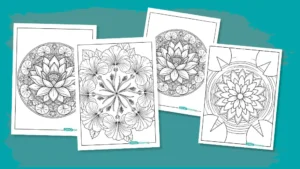
Tap any picture below to open it, then download the high-resolution PDF and print it on Letter-size paper:






Eight Flowers, Eight Different Moods
The eight flowers in this collection are very different from one another. Some have wide petals that are easy on a first-time colorer, and others have thin, spoke-like petals that test even a patient hand. I arranged them in the same order our afternoon unfolded. Read on and see which page ends up in whose hands at your house.
Sunflower: Where Our Afternoon Began
My son noticed the center of the sunflower first and asked how the seeds got packed so neatly. The answer is the Fibonacci sequence, where the seed rows spiral in two directions at once. That round center is not one flower at all, but a cluster of hundreds of tiny ones. Young sunflowers also turn their buds to follow the sun across the sky all day. After hearing that, my son grabbed three shades of brown and colored the center rows one at a time. He saved the petals for the next sitting.
Lotus: Cool Colors After All That Yellow
After all that yellow and brown, my son wanted something cool, so he pulled over the lotus page. Its pointed petals open layer by layer, and a ring of lily pads surrounds the bloom. He filled the petals with pinks that faded into soft purple and used two greens for the pads. A real lotus plants its roots in the muddy bottom of a pond, yet its petals come up clean. Water beads up on the leaves like pearls and rolls off, carrying dust with it. Lotus seeds can stay alive for hundreds of years.
Dahlia: When Your Hand Wants a Challenge
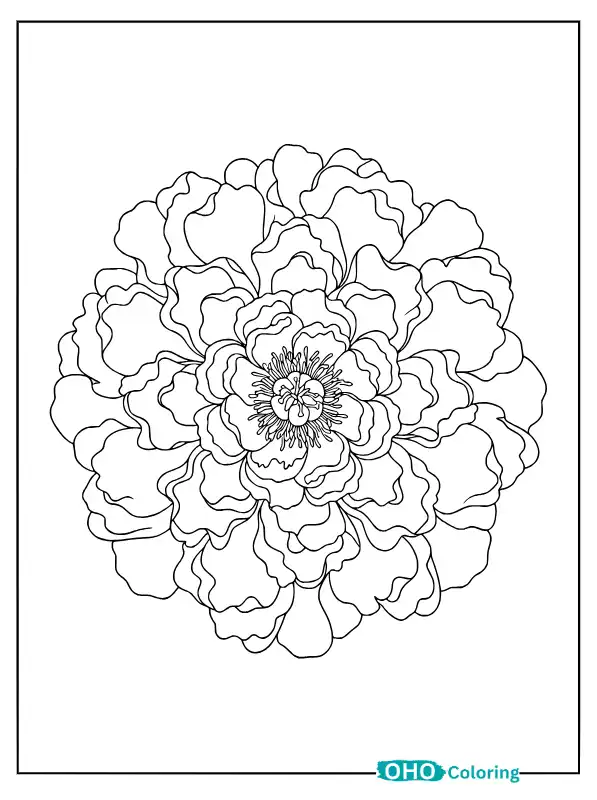
When the lotus was finished, my son announced that he wanted something harder. The dahlia page fits that request, because each layer of pointed petals asks for its own color. He put deep red in the middle, orange around it, and yellow on the outside, and the page started to look like a flame. This much detail goes best with a sharp colored pencil. The dahlia is the national flower of Mexico, and it was named after Anders Dahl, a Swedish botanist. It belongs to the same plant family as the sunflower, so the two pages share a little family resemblance.
Rose: Soft Curves After Sharp Points
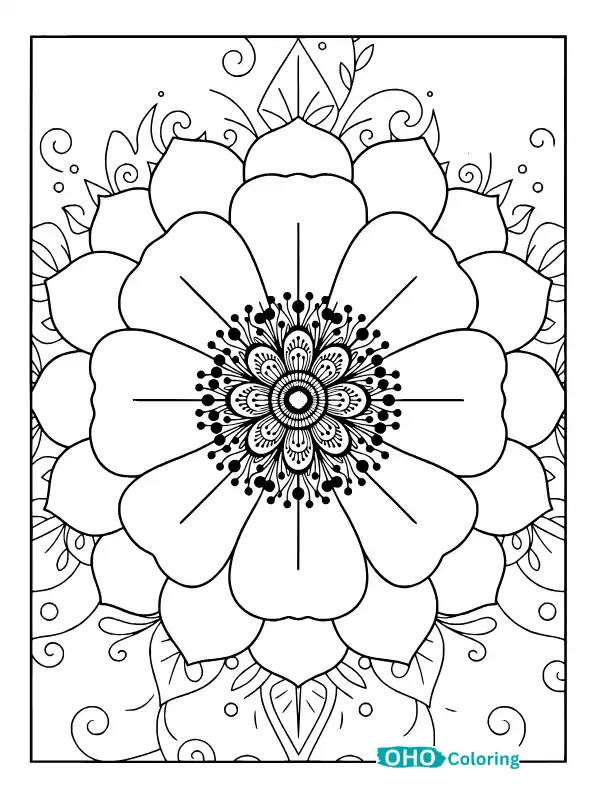
His hand was tired from all those straight, pointed lines, so I handed him the rose page. The open bloom in the center is built from curling petals, and a wreath of leaves and vines surrounds it. I asked him to use light and dark shades of a single color here. A light touch on the edges and a bit more pressure near the center gives the petals real depth. Roses are ancient, and fossils of roses about 35 million years old have been found. The fruit of a rose is called a rose hip, and it is rich in vitamin C.
Chrysanthemum: The Patience of Spoke-Like Petals
After the soft curves of the rose, my son chose the chrysanthemum, the page that asks for the most patience in this collection. Its thin petals spread out in tight rings like the spokes of a wheel. I’d suggest it for teens and adults, and it looks best when two shades of one color alternate from ring to ring. The word chrysanthemum comes from Greek words meaning golden flower. In Japan the flower is so respected that it has its own yearly festival, and in China people drink tea made from the dried blossoms.
Zinnia: Neat Rows of Petals
After the fine detail of the chrysanthemum, the zinnia page gives the hand a little rest. Its wide, spoon-shaped petals sit in tidy rows around a domed center. Kids ages 9 to 12 can finish it without getting tired, and one color per row makes the whole flower look like a crown. Zinnias come from Mexico and Central America, and butterflies are drawn to them. In 2016, zinnias were grown on the International Space Station, and one even bloomed there. The flower was named after Johann Gottfried Zinn, a German botanist.
Cherry Blossom: Emma’s First Pick
By then Emma had wandered back, and none of the pages so far were right for her. So I pulled out the cherry blossom page, where separate five-petal flowers sit along the branches. Each flower is small and stands on its own, so kids ages 5 to 7 can fill one flower with one color and feel the satisfaction of finishing it. Cherry blossoms last only a week or two in Japan, and people gather under the trees for hanami, a picnic held to enjoy the flowers. Emma chose light pink and spent ten whole minutes on the very first flower.
Hibiscus: A Bright Flower That Lasts a Day
When the cherry blossom was done, Emma asked for the hibiscus page herself, since its petals are big and wide open. Curved stamens fan out from the center like a hand fan, and yellow or gold looks best on them. I told her that many real hibiscus flowers last only a single day, but the plant opens a fresh one the next morning. The yellow hibiscus is also the state flower of Hawaii. Emma colored every petal a different color and asked me what color tomorrow’s flower would be.
Age-by-Age Tips for Coloring Flower Mandalas
The most useful lesson from that afternoon was about age. Mandalas are not a good fit for toddlers ages 1 to 3, because at that age thick crayons and big scribbles are exactly right. Preschoolers ages 3 to 5 can handle one or two big petals and two or three colors, and it’s best not to correct them when the color slips outside the lines. Kids ages 5 to 8 can fill one ring with one color, and it’s perfectly fine if a page takes several days to finish.
Kids ages 9 to 12 often finish a whole page, like my son did. At this age, show them how warm and cool colors work together, because that is what gives a page its character. Teens and adults can color from the center outward, which keeps the whole picture balanced. Four or five colors are plenty for a single page, and using a different color on neighboring petals keeps each one distinct. Layering colored pencils gives nice shading. If you use gel pens or fine-tip markers, slip a spare sheet of paper behind the page.
Underneath all of this sits the question of paper, which people often forget. For fine detail and heavy layering, 65 lb cardstock or heavier holds up well. And if a page doesn’t get finished in one sitting, pick it up next time right where you left off. Our sunflower petals took three days to finish, and there was nothing wrong with that.
Before You Print
These pages are in 3:4 portrait format, so choose “Fit to page” in your print settings to keep the border line from getting cut off. Standard Letter paper (8.5 x 11 inches) works well, and the page sits on it without stretching. Pages with fine petals, like the chrysanthemum and dahlia, print fine on regular 20 lb copy paper. For layered colored pencil or gel pens, though, a heavier sheet such as 65 lb cardstock is better. Check the print preview once, then print the rest of the pages together.
One Last Thing
Since that Sunday, a new flower has been colored on our kitchen table every week. Some weeks my son gets lost in the layers of the dahlia, some weeks Emma spends all afternoon on a single hibiscus petal, and sometimes I quietly fill in the chrysanthemum spokes. No matter how fast or slow a page gets finished, there are always a few minutes when all three of us sit at the same table, coloring in silence. Pick the page from the eight above that fits your age and patience, print it, and start today. If you enjoy these, take a look at our other coloring pages too.
Terms of Use
All of these coloring pages are free for personal, home, and classroom use. Selling them, reposting them on another website, or distributing them commercially is not allowed.