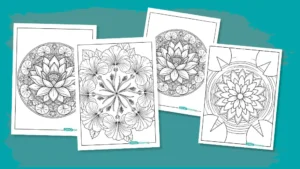
We made fourteen butterfly mandala pages, and all of them can be printed from the grid below. Some feature the spread wings of a monarch, a swallowtail and a blue morpho, while others show a caterpillar becoming a butterfly by way of a chrysalis. Butterflies resting on flowers and night-flying moths are in the set too.
Coloring that many pages at once wasn’t possible, so out of these Butterfly Mandala Coloring Pages we picked six and colored them by hand. Each page took several evenings, sometimes because we got stuck on the stripes of a wing, sometimes because of the dots along an edge. Along the way we figured out which color combinations make a page glow and where rushing backfires. We also picked up some facts about real butterflies, and you’ll find them below next to the pages they belong to.
Download Your Free Butterfly Mandala Printables
Every page in this set is ready to print. Click an image to see it larger, save the high-resolution PDF, and start with whichever butterfly catches your eye first.



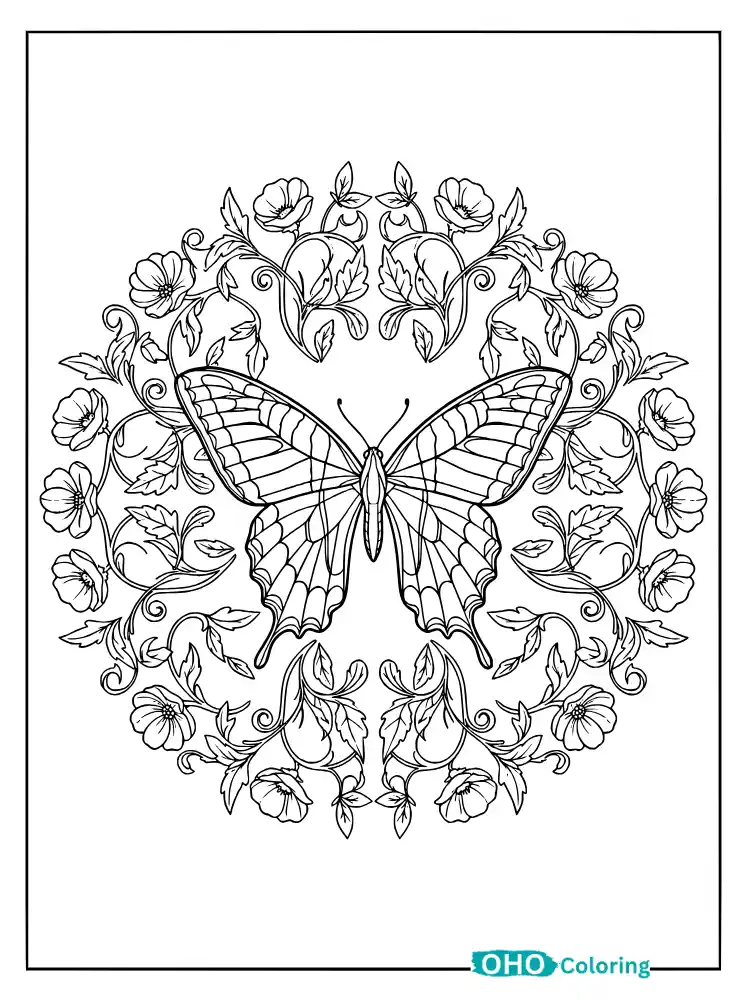
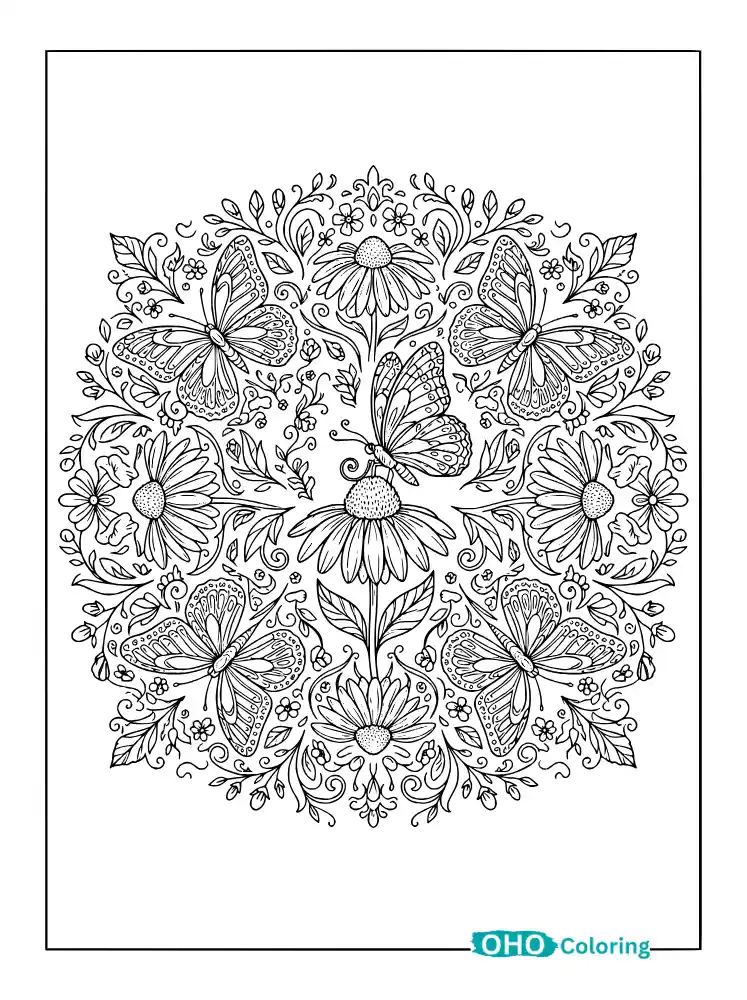
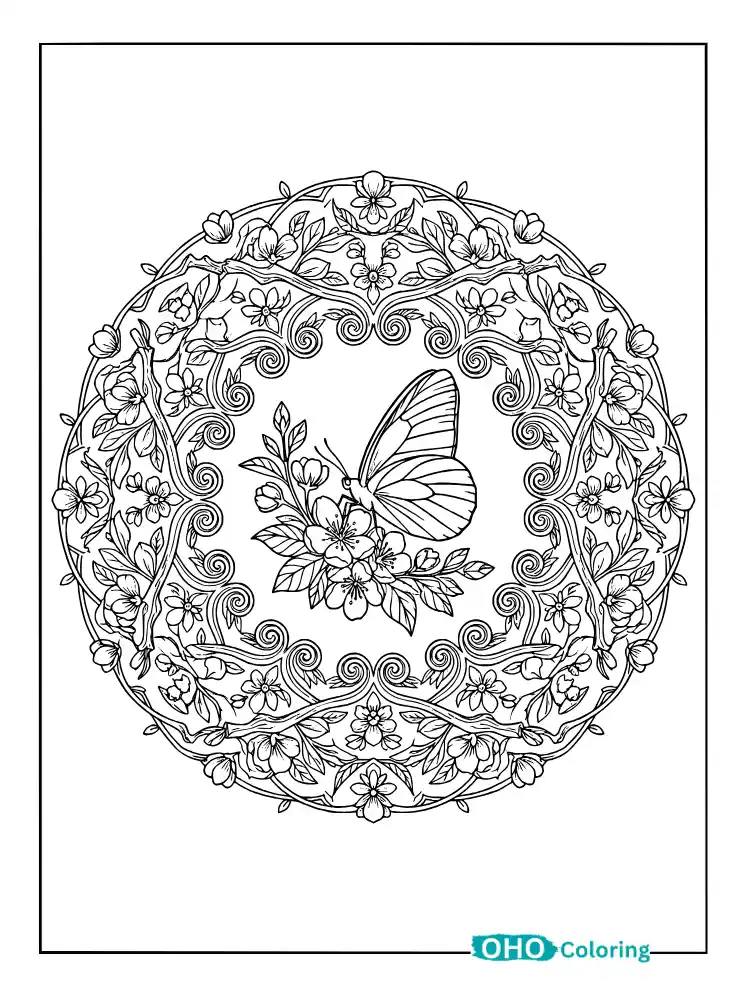
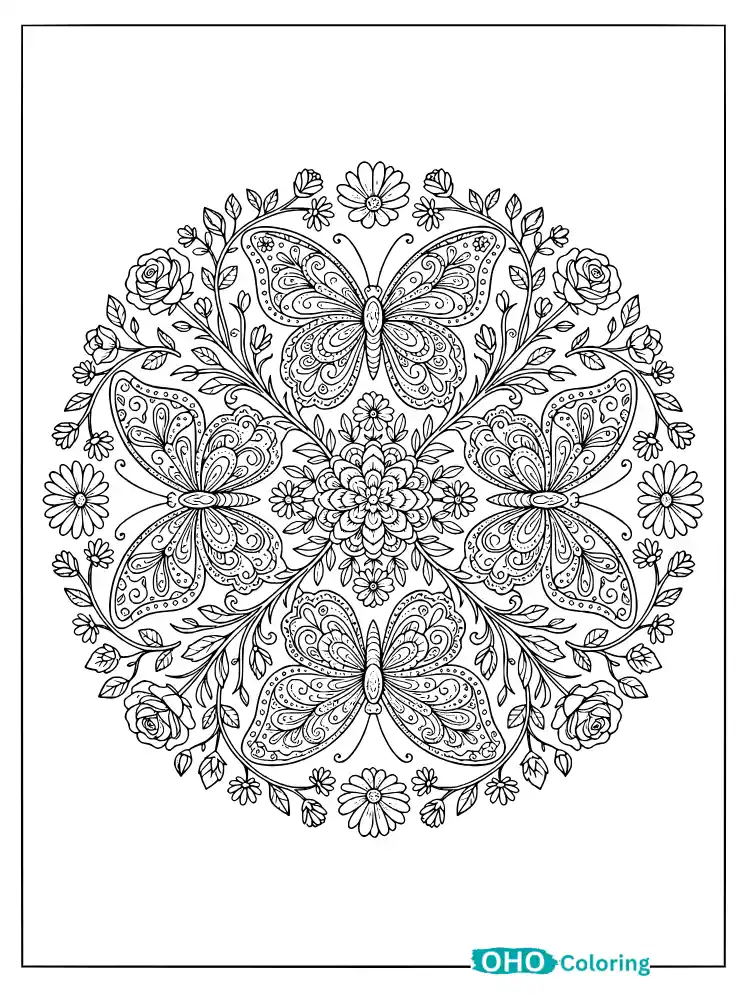


Six Butterfly Mandala Coloring Pages We Colored by Hand
These six pages follow a butterfly’s story from a hungry caterpillar to wings that cross whole continents. We colored them one at a time, and each page taught us something new about the insect and about color. The notes below cover what we tried, what worked and what we would change.
The Caterpillar Resting in a Circle of Leaves
We colored the caterpillar page first, because every butterfly’s story begins here. A round, curled caterpillar sits in the center, and leaves, tiny eggs and buds are arranged in a ring around it. A caterpillar’s whole job is to eat. In just a few weeks its weight grows hundreds of times over, and as its skin gets tight, it sheds it again and again. A monarch caterpillar eats nothing but milkweed.
That’s why we split the leaves into four shades of green, from lime green to deep olive green. Every segment of the caterpillar got its own color, so the curve of its body shows its changing shape too.
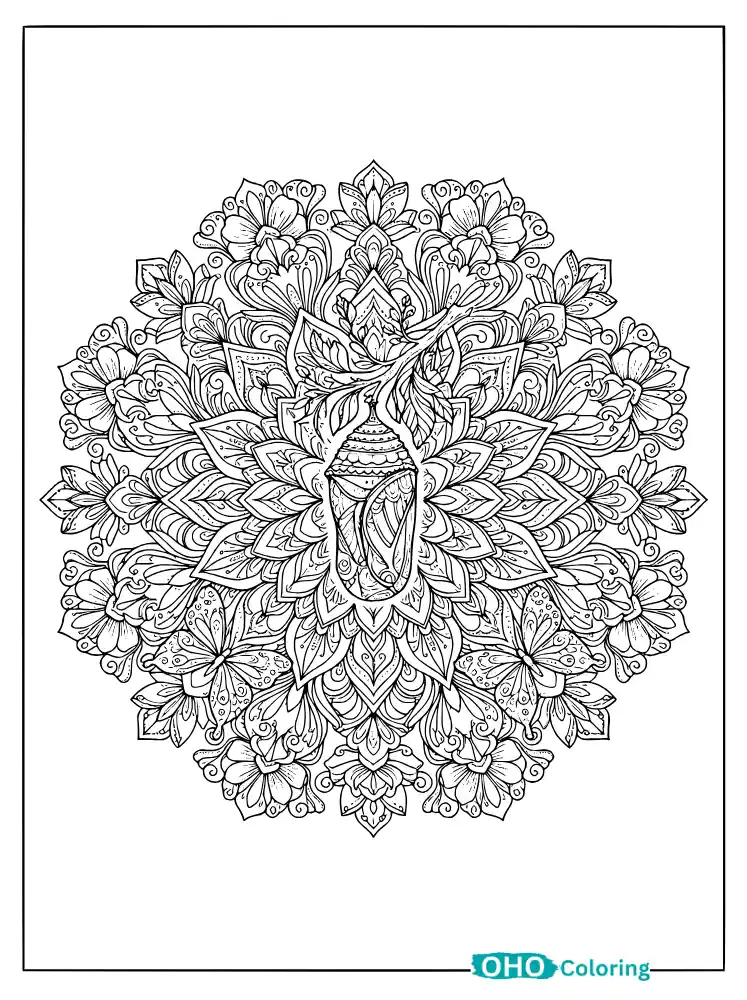
A Hanging Chrysalis and Layers of Blooming Flowers
Once a caterpillar stops eating, the next page begins. Here a chrysalis hangs straight down from a twig, and layers of blooming flowers spread outward around it in circles. People often mix up a chrysalis and a cocoon, but a butterfly’s shell is called a chrysalis, while a cocoon is what most moth caterpillars spin from silk. Inside the shell, the caterpillar’s body completely rebuilds itself. For a monarch, this takes ten to fourteen days.
On this page we colored the chrysalis in green and soft gold. The flower layers went from yellow to orange to pink, moving from the inside out, so the whole ring looked like it was slowly opening.
A New Butterfly Opening Damp Wings
When the wait inside the shell is over, the next page comes into view. A new butterfly spreads its damp wings beside the empty chrysalis, and behind it a sunburst of sharp rays and rounded petals opens wide. A butterfly’s wings come out crumpled and wet. It pumps fluid into them to stretch them out, then rests quietly for a few hours while they dry. No butterfly can skip this step, no matter how eager it is to fly.
We colored the wings in light shades here, since they’re brand new and soft. The rays and petals got darker colors, so the butterfly in the middle would stand out.
Monarch Wings and a Ring of Daisies
Once its wings have dried, they become a butterfly’s calling card, and monarch wings show this best. On the page, the spread wings carry fine veins and carved edges, with daisy petals circling around them. A monarch’s orange and black warns hungry birds, because eating milkweed makes the butterfly taste bitter. In winter, these same butterflies fly about 3,000 miles from the United States and Canada to Mexico, and the trip back north takes several generations.
We used two shades of orange, one light and one dark, so the wings wouldn’t look flat. The daisies got cool colors, which made the butterfly pop.
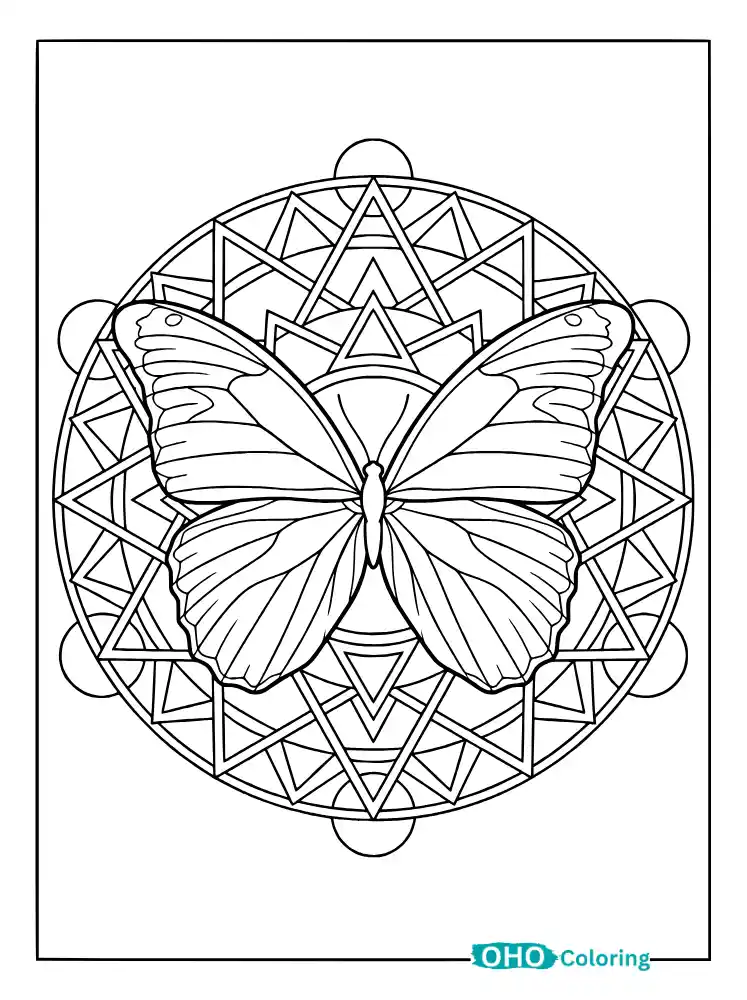
Blue Morpho and the Geometric Frame
A monarch’s orange comes from real pigment, but the blue morpho is a different story. This butterfly from Central and South America has no blue pigment in its wings at all. The surface is covered in tiny scales, and their structure bounces light back in a way that looks blue. That’s why the color seems to shift when the angle changes. When the wings fold, the underside turns out to be brown with eye-like spots, and the butterfly disappears among the leaves.
This page tested us the most, because triangles and circles interlock all around it. We filled them in with six shades running from blue to purple, and only then did that shifting shimmer show up on paper. If you like more triangle-and-circle patterns like these, you’ll find them in our Mandala Coloring Pages too.
Painted Lady and Honeycomb Hexagons
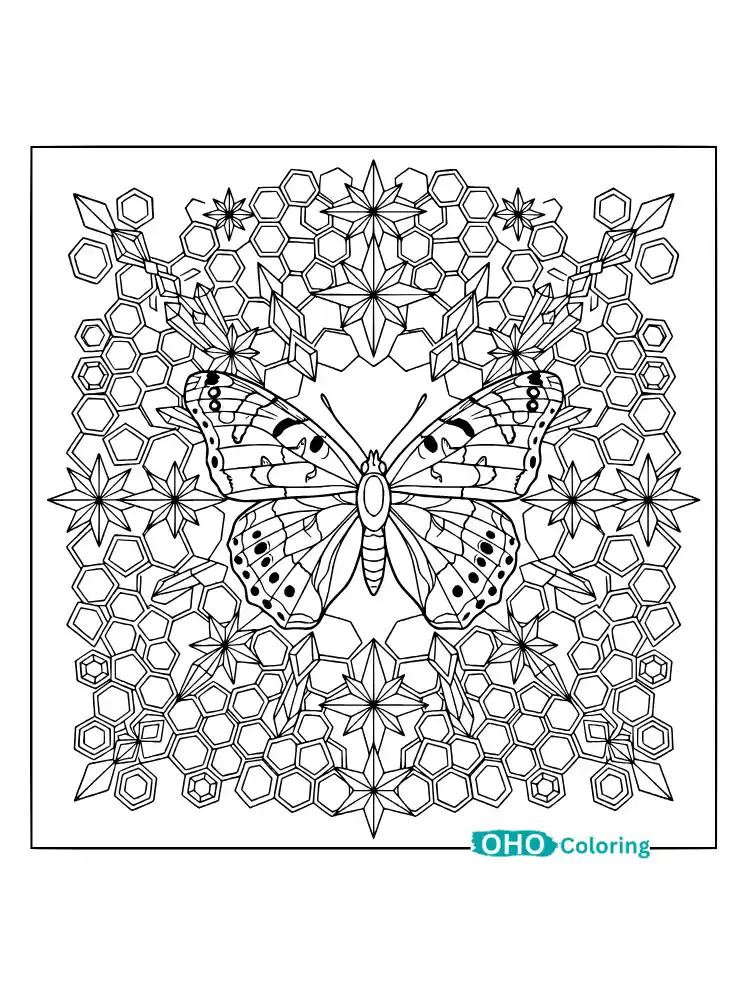
The blue morpho hides in the forest, but the painted lady spends its life on the move. This butterfly lives on several continents and covers thousands of miles as the seasons change. No single butterfly makes the whole trip, because the route is completed generation by generation. Its wing edges are dotted with spots, and on the page they’re surrounded by a pattern of honeycomb hexagons and star-shaped crystals.
We filled the hexagons with two colors in alternating order, and the honeycomb shape stood out clearly. The large center areas stayed in warm, plain colors, so the fine work along the edges would show up against them. If you’d like to color the shapes of other creatures after butterflies, our Animal Mandala Coloring Pages have fine patterns like these too.
Easy Tips for Coloring Butterfly Mandalas
On all six pages we colored, one thing kept showing up: a mandala’s whole charm lies in repetition. So start with colored pencils or fine-tip pens, since the lines are thin and heavy colors can swallow them. Fill in the butterfly in the middle first, then work outward toward the petals, so the colors of the ring keep matching the butterfly.
Keep the color order the same on both wings. If the first stripe on the left wing is orange, make the first stripe on the right wing orange too. That symmetry is what makes a mandala feel complete.
Using fewer colors makes the job easier. Four to six colors are plenty for a whole page, because too many colors make the pattern look scattered. Try your colors on a separate sheet of paper first, and you won’t regret anything on the real page.
Once your colors are set, practice filling a single color from light to dark. Press lightly at the base of a petal and a little harder toward the edge, and the petal starts to look rounded. Leaving some spots empty matters just as much. The white between the veins of a wing gives the colors room to breathe.
Last of all, add gel pens or metallic pens along the edges and dots for a raised, shiny finish. Don’t rush this step. Kids ages 10 to 12 and up (grades 5 to 7) who can sit patiently can try these pages too, while toddlers and preschoolers do better with plain pages that have thick lines.
Don’t pressure yourself to finish a whole page in one sitting. Color for half an hour, set it down, and come back the next day, because a mandala colored slowly often looks cleaner in the end.
We colored six of the fourteen pages, but all sixteen in the grid are open to you. The wildflower wreath around the tiger swallowtail, the butterfly resting on cherry blossom branches, the antennae medallion, or the night moth among night-blooming jasmine: whichever one catches your eye first, download it and start there. More designs are waiting in our Mandala Coloring Pages collection.