Almost every kid can spot a daisy from across the garden: a round yellow center with a ring of petals around it. When my son first drew a flower, it was exactly that, a yellow circle with long lines sticking out. That simplicity is why these Daisy Flower Coloring Pages suit a four-year-old holding a chunky crayon, and an older kid who wants to spend a whole afternoon on small details.
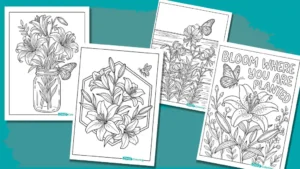
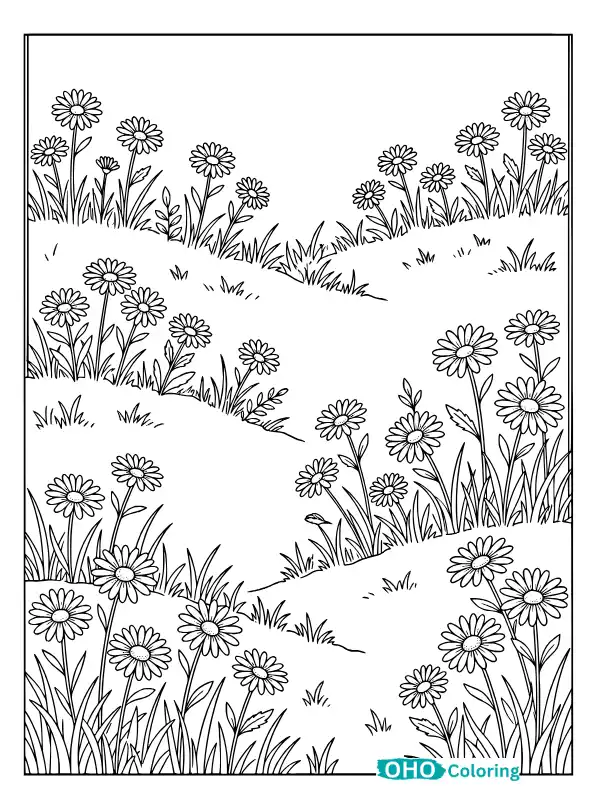
Daisies come in more shapes than most people expect, so we prepared 21 pages to show them. Some have slender petals, some have broad layers, and others have tight button-like clusters. Then come bouquets, a wreath, a mandala and a wild meadow. Every page has clean lines and plenty of open space, so crayons, colored pencils and markers all work well.
Printable Daisy Flower Coloring Pages
Pick any sheet from the grid below. Tap an image to open it, then download the high-resolution PDF and print it at home.








Four Daisies to Start With, and How to Color Each One
You now have all 21 pages, but in this post we are talking about only four of them: the Shasta daisy, the Gerbera, the English button daisy and the close-up of the flower’s center. We picked these because each shows a different side of the flower, and each one is colored a little differently. The other 17 pages, with their bouquets, vase arrangements, wreath and mandala, are there for kids to explore on their own. Once these four are done, those will feel much easier.
The Shasta Daisy
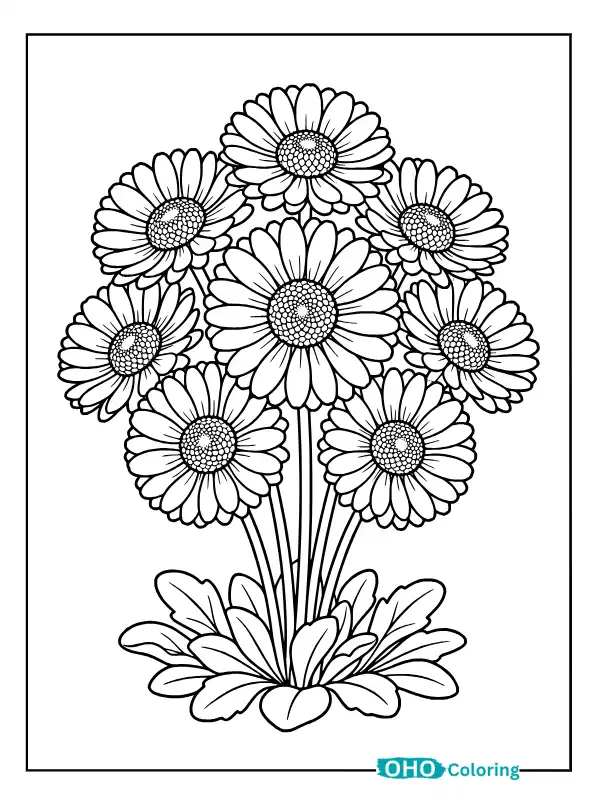
The Shasta daisy page is the best place to begin. It has wide petals, a textured center and a slim stem with two leaves, so a young child can finish it without getting lost.
While your little one colors, you can mention that “daisy” comes from an old English phrase meaning “day’s eye.” The flower opens with the morning sun and folds its petals again at dusk. Ask whether their daisy is a morning one or an evening one. For morning, fill the center with deep yellow and add a faint blue shadow along the petal edges, which makes the white look freshly opened.
The Gerbera Daisy
A Shasta has a single ring of petals, but the Gerbera has several rows, and that gives kids more chances to change colors. Try orange on the outer row, pink in the middle and red near the center, so the flower deepens as it goes inward.
Gerberas come from South Africa and grow in red, yellow, orange and pink. A true blue Gerbera does not occur in nature. If your child colors one blue anyway, tell them they have made a flower you would almost never see in a garden. Kids often color the next petal with even more confidence after hearing that.
The English Button Daisy
The Gerbera is big and full, while the English daisy page shows a cluster of small, round flowers. This plant, known as Bellis perennis, often pops up on its own in the middle of lawns. It stays so low that a few blooms usually survive the mower.
Since there are several flowers on this page, coloring them all the same makes it look flat. Give one a yellow center, the next an orange one and the third a golden one. The petal tips of a real English daisy often carry a pink blush, so a little pink along the edges is accurate too.
The Center Close-Up
After the little flowers comes the close-up of the center, which holds the most surprising fact about daisies. What looks like one flower is really hundreds of tiny flowers packed together. The yellow middle is made of tiny florets, and each “petal” around it is a separate small flower as well.
With that in mind, ask your child to dot every grain in the center. Fill it with yellow, then add small brown flecks on top, and the center starts to look raised. It is slow work, but kids stay with it because they now know they are coloring a crowd of flowers.
Tips for Coloring a Daisy Flower
The four pages above will probably leave your kids asking for another, and a few small habits make the next ones better. They apply equally to all 21 pages.
White petals do not have to stay blank. A light touch of gray, blue or lavender at the base of each petal makes the flower lift off the paper. Keep the color pale and the pressure gentle.
The center deserves the same attention, since solid yellow alone looks flat. Add a small orange ring over the yellow and a brown dot in the middle. Young kids get good practice from this, because they learn to color inside a tiny space.
Once the flower is finished, move on to the stem and leaves. Use a darker green for the stem and a yellowish light green for the leaves, and leave the center vein of each leaf uncolored so it looks real.
Matching the page to your child’s age saves frustration. A beginner will do well with the minimalist single-stem daisy, which has big petals and one simple center. An older kid with more practice can take on the Zentangle-patterned daisy mandala, where the petals are filled with small designs.
The paper matters too. If you plan to use watercolors or markers, print on thicker paper, because thin sheets let the color soak through. For pencils and crayons, regular printer paper is enough.
Last, think about the background. Ask your child where their daisy is growing: under a morning sky, in a backyard or in a pot on a windowsill. Then fill in a pale blue or soft yellow behind it, and the white petals will stand out even more. Put the finished page on the fridge, because a kid who sees their flower every day usually asks for the next page without being told. Whenever those four are done, all 17 pages are waiting in the grid above.