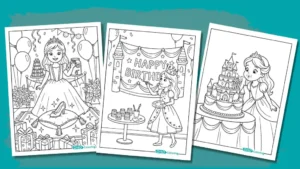
A few days ago my daughter was sitting at the kitchen table with a lopsided crown she had cut out of old cardboard, covered in glitter. She put it on her head and asked, “Mom, when does a real princess wear this?” I laughed, because the answer wasn’t simple. A princess didn’t wear the same crown for every occasion. That very evening I decided to make these Crown Coloring Pages.
The set includes fifteen different crowns, because every child likes something different. My daughter picked five out of the fifteen and colored only those. She saved the other ten “for later.” The story of those five is below.
Featured Crown Coloring Pages
Here are all fifteen crowns from our collection. Every child falls for a different one, so scroll through and let your little artist pick a favorite first. My daughter went straight for five of them. Click on any image to open it, then download the high-resolution PDF and print it at home.






The Crowns My Daughter Colored (and When Each One Was Worn)
Out of all fifteen pages, my daughter picked five and colored them one after another. Without planning it, she ended up going from the smallest evening jewel to the heaviest crown of all.
I’ll take them in the order she colored them, and I’ll tell you what she learned about each one along the way.
The Little Tiara Resting on a Cushion
My daughter grabbed this page first and said, “I’m going to make the heart gems pink.” It’s a three-pointed tiara resting on a velvet cushion, with pearls hanging below. A tiara doesn’t cover the whole head. It sits above the forehead, on top of the hair. That’s why it looks lovely with loose hair and with a high bun.
In the old days, a tiara was considered an evening jewel. A princess wore it to dinner banquets and dances, not during the day. Only a bride was allowed to wear one in the daytime, on her wedding day. When I told my daughter this, she said right away, “Then this is the wedding-day crown.”
She got stuck for a moment on the pearls. I told her that a real pearl forms inside an oyster. When a tiny particle slips inside, the oyster keeps coating it with shiny layers. After hearing that, she left the pearls white and added just a little gray shading along the edges. They looked truly round.
The Filigree Circlet: A Crown for a First Grand Banquet
A tiara was an evening jewel, but a princess going to her first grand banquet often needed something even lighter. My daughter’s second pick was exactly that kind of circlet. It has swirling, delicate wirework, a teardrop diamond in the center, and pearls dangling from the edge.
This kind of wirework is called filigree. Very thin threads of gold or silver are twisted into curling vines, and even one small design can take a craftsman hours. The wires are so light that the circlet stays on the head even while dancing.
On this page my daughter picked up colored pencils, because the marker was bleeding into the tiny spaces. She kept the wirework silvery gray and colored the diamond sky blue. She left one small spot white in the middle, and the diamond really did sparkle.
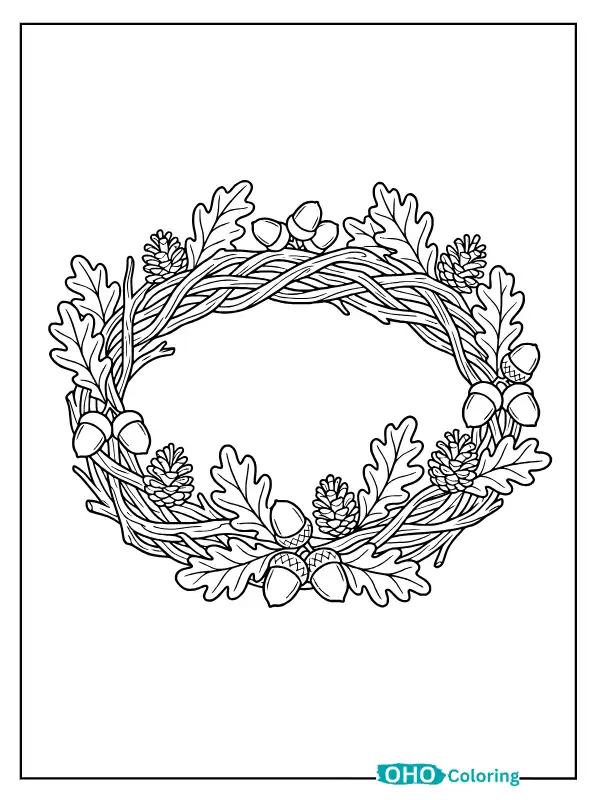
The Greek Laurel Wreath
After the evening jewels, my daughter said she wanted something she could wear in the garden. She chose the wreath of leaves. There’s no gold or diamond on this page, just olive branches and little berries tied together at the back with a silk ribbon. This tradition comes from ancient Greece, where a wreath like this was placed on the head of a winning athlete. At the Pythian Games in Delphi, the prize was a laurel wreath, while at the Olympics it was a wreath of wild olive.
A wreath of leaves is light and doesn’t show off, so a princess wore one to daytime festivals or on a walk through the garden. My daughter didn’t fill every leaf with the same green. She made some light, some dark, and put two or three yellow ones in between, as if autumn were on its way. The wreath started to look just like fresh branches.
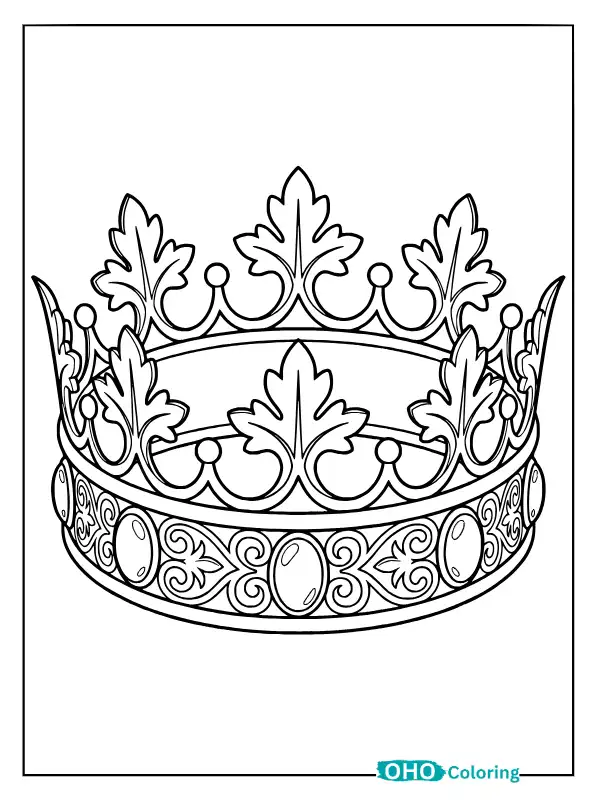
The Ruby Coronet: A Mark of Rank
The crowns so far were about hobbies and occasions. My daughter’s fourth page was different, because its real job was to show the wearer’s rank. A thick golden band has points shaped like strawberry leaves, and oval rubies are set around the base. This is a coronet, a crown for a rank below a king or queen.
In Britain, the coronets of royal family members carried set designs that matched their rank. Just by looking at the crown, you could tell who was wearing it. At formal state events, a princess wore a crown of this kind.
The rubies are called cabochons, which are smooth, rounded, polished stones with no cut facets. Their glow isn’t as sharp as a diamond’s. It’s softer and deeper. My daughter filled them with deep red and left a tiny white mark in the upper corner of each one. Then she held the page up to the light and said, “Look, they’re shining.”
The Heavy Coronation Crown
Above the coronet there is only one crown left, and it isn’t meant for a princess. This was my daughter’s last page, with crisscrossing jeweled arches, a cross on top, and a spotted band of ermine fur below. Arched crowns like this were made for a monarch. Britain’s St. Edward’s Crown was made in 1661 and weighs more than two kilograms, about five pounds, so it is worn only on coronation day. When she heard that, my daughter grabbed her neck and said, “That heavy? Then being a king must be hard!”
The ermine fur has a story of its own. It came from the white winter coat of an animal called the stoat, and the black spots are actually the black tips of the stoat’s tail. My daughter kept the fur white and filled in the spots with dark color. The red and gold of the arches stood out even more against it.
Easy Tips for Coloring Crowns
Please don’t be overwhelmed by fifteen pages. You don’t have to color all of them. Start with whichever crown your child likes at first glance. My daughter colored five and left the other ten for next time, and I never felt anything was missing.
Before choosing colors, ask your child when this crown will be worn. Blue, purple, and silver look good for an evening crown. Green, yellow, and pink suit a daytime crown. When a child thinks of the occasion first and then picks up a color, the coloring turns into a little story on its own.
Three or four colors are plenty for the gems, such as red, blue, green, and purple. Repeat them in turn, and the crown looks tidy and the colors don’t clash.
For the golden parts, start with yellow, then add a little light orange in the shaded spots. Even without a gold pen, that’s enough to make a crown glow.
Speaking of shine, leave a small spot of white in every gem. Once kids learn this trick, they try it on every page, and then they ask if they can do it on other things too.
Leave the pearls and the fur areas the color of the paper. Just add light shading, so they stand out against the other colors.
When picking a pen or pencil, look at the texture of the page. Colored pencils glide easily over fine wirework, while markers work better for thick bands and leaves.
And when the page is finished, ask your child what day the crown will be worn. The answer is often more fun than the coloring. Last time my daughter said she would wear hers to Grandma’s birthday, and she stuck the page on the fridge.