These Kwanzaa Coloring Pages bring you scenes from a seven-day tradition celebrated by African American families across the United States. The holiday runs from December 26 to January 1 every year. Each evening, the family gathers in one spot and lights a new candle. The kids count with growing excitement: how many flames are burning tonight, and how many are still waiting? That counting, and that waiting, is the heart of these pages.
It’s why I kept the lines thick and the shapes big, so even a three-year-old can pick up a crayon without feeling nervous. Older kids get full freedom to choose their own colors. So print a few sheets, open the crayon box, and see what that very first flame looks like.
Printable Kwanzaa Coloring Pages to Download
Tap any picture to open it, then save the full-size PDF and print it at home.













Kwanzaa Coloring Pages Highlights
The First Evening Begins with the Black Candle
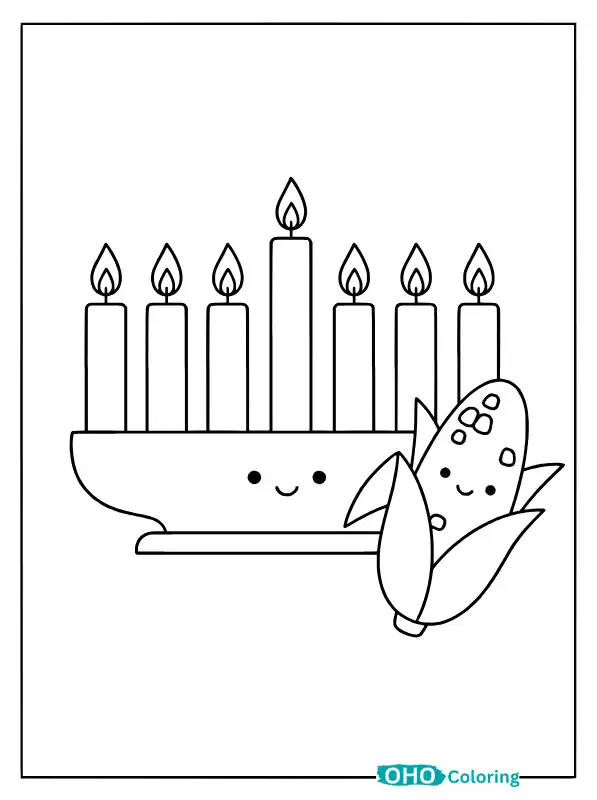
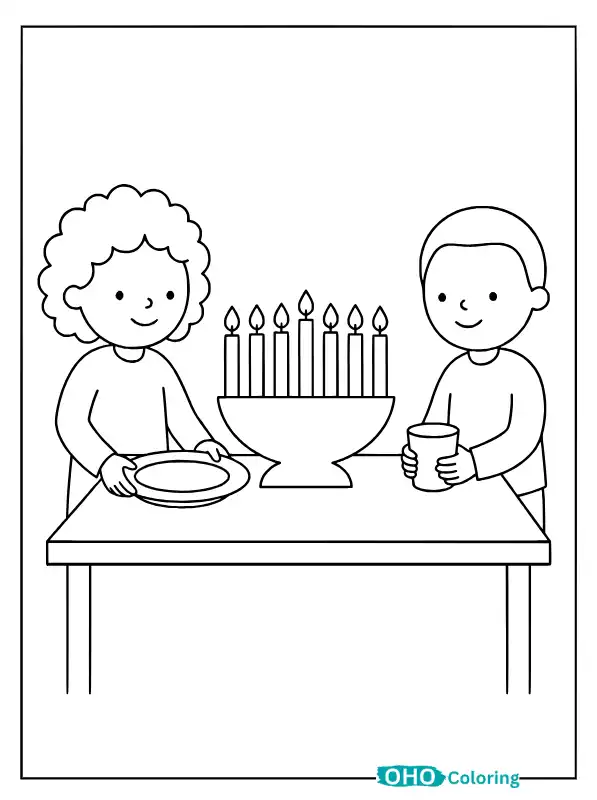
On the first page, a girl holds a slim taper and reaches toward the center candle. She’s holding her breath, because tonight the honor of lighting the very first flame is hers. The holder those candles sit in is called a Kinara, a word from the Swahili language. It holds seven candles: one black in the middle, three red on the left, and three green on the right. On the first night, the black candle is lit. On the second night, it’s the first red candle on the left, and on the third, the first green one on the right.
That back-and-forth pattern continues through the seventh night. While you color, ask your child which candle should get which color. That way, the order sticks without any memorizing.
Ears of Corn, One for Every Child
Right beside the candles, three plump ears of corn rest on a mat, and a little boy is touching one of them. His smile says he already knows which ear is his. In this tradition, corn is called Muhindi, and a home sets out as many ears as there are children.
Even a home without children puts out one ear, because every child in the community is considered everyone’s child. The woven mat underneath is called the Mkeka, and all the other symbols rest on top of it. That’s also why the holiday’s name connects to the harvest. “Kwanzaa” comes from the Swahili phrase “matunda ya kwanza,” which means “first fruits.” Try yellow for the kernels and a soft green for the husks.
The Two-Handled Cup and the Shared Sip
After the corn and the mat, the next symbol is a big cup, which two children hold together on page eight. It has a handle on each side, so lifting it alone is tricky. That’s exactly the point, because it’s called the Kikombe cha Umoja, or Unity Cup. The oldest member of the family first pours a little water onto the ground to remember the ancestors. Then the cup travels from hand to hand, and everyone takes a sip.
“Umoja” means unity, and it’s the very first of the seven principles. Fill in the cup with a woodsy brown, but give the two kids shirts in different colors. That way it’s clear that two different people are holding one thing together.
Four Children in a Circle
That same idea of unity grows even bigger on page eleven, where four children hold hands in a circle with a Kinara in the middle. A circle has no end, so no child gets left behind. Umoja and the six that follow make up the seven principles, known as the Nguzo Saba. The other six are Kujichagulia (self-determination), Ujima (collective work and responsibility), Ujamaa (cooperative economics), Nia (purpose), Kuumba (creativity), and Imani (faith).
Each evening focuses on one principle. The conversation opens with “Habari gani?”, which means “What’s the news?”, and the kids answer by saying the name of that day’s principle. Give each of the four children a different color of clothing, then fill in the candles in the middle with black, red, and green.
Grandpa’s Rocking Chair and Stories of the Ancestors
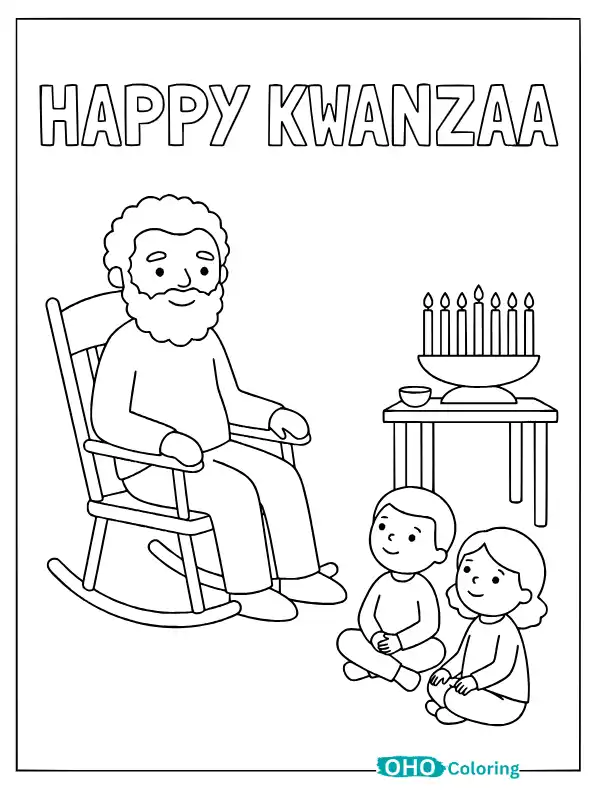
The seventh day is about faith, and nobody explains it better than Grandpa. On page seventeen, he sits in a rocking chair while two children at his feet listen with wide eyes. The story has probably reached a spot where nobody can get up before hearing the next sentence. Imani, or faith, means trusting in your elders, your community, and yourself.
It’s that trust Dr. Maulana Karenga had in mind when he started the holiday in 1966. Fill in the chair with a deep brown, and put a color on Grandpa’s sweater that reminds you of an elder in your own family.
The Karamu Feast on December 31
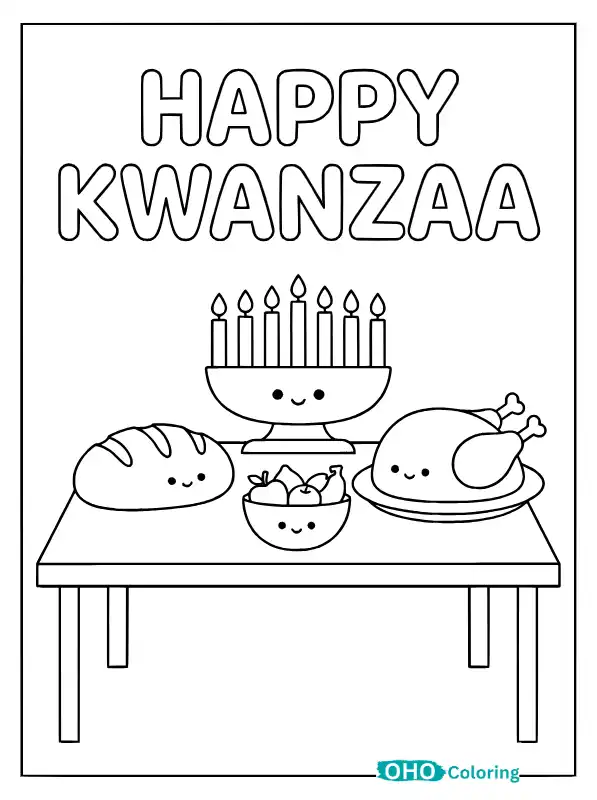
Six days go by while the stories are told, and on the evening of December 31, the whole family gathers for a feast. On page eighteen, a long table is set with a big platter of roasted chicken, a bowl, a loaf of bread, and a glowing Kinara in the center. This feast is called the Karamu. Along with the food, there’s music, dancing, and time set aside to remember the ancestors.
The table often holds collard greens, sweet potatoes, and sweet potato pie, and kids usually pitch in to help make them. Color the chicken a golden brown, brush a soft yellow over the bread, and give the bowl a bright color so it’s the first thing anyone notices on the table.
Easy Kwanzaa Coloring Tips
Start with the candles, since black, red, and green are the heart of this holiday. Once those three colors are in, choosing colors for the rest of the page gets much easier. For the flame, layer a little orange over yellow and leave a small white spot at the very top, which makes the flame look like it’s glowing.
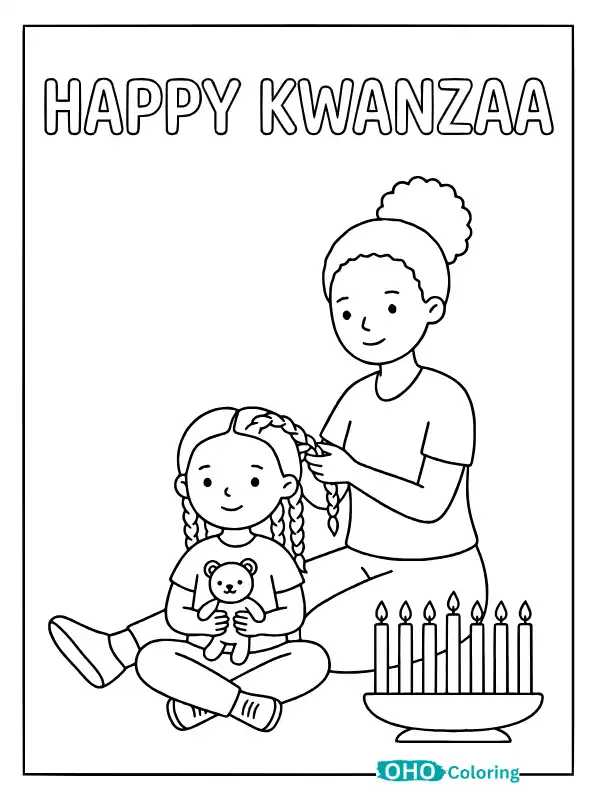
The mat has no pattern printed on it, so kids can draw their own wavy or crisscross stripes to make it look woven. With three-year-olds, ask them to color in one direction, which keeps the page neat. For clothing, remind them of traditional African attire: draw big squares or triangles on a loose dashiki shirt or a colorful headwrap.
For faces and hands, keep three browns nearby: light, medium, and dark. That way every child can find themselves in at least one of the characters. Older kids can write on the back of each page which principle is hiding in that scene. That bit of writing later becomes a conversation starter about the page.
Finally, hang all seven pages in order on a string. From December 26 to January 1, open one page a day and spend two minutes talking about that day’s principle.