My daughter Emma pressed her nose against the aquarium glass and stared at one jellyfish for a full ten minutes. Then she turned to me, dead serious, and asked, “Mom, if it doesn’t have a brain, how does it know where to go?” I didn’t have the full answer, so when we got home, we opened some books and pulled out the crayons at the same time.
That evening’s fun is how these Jellyfish Coloring Pages came to be. A creature with no bones, no heart, and no blood has been drifting through the ocean for about 500 million years, which is even longer than the dinosaurs have been gone. Emma gave every jellyfish on every page a name, and the story kept rolling right along with those names.
Jellyfish Coloring Pages Download
Pick your favorite jellyfish below and tap the image to open it. From there, you can download the high-resolution PDF and print it at home in a few seconds. Each sheet has clean, easy-to-color outlines, so it works well with crayons, markers, and colored pencils.












How Did “Bello” Learn to Swim Without a Brain?
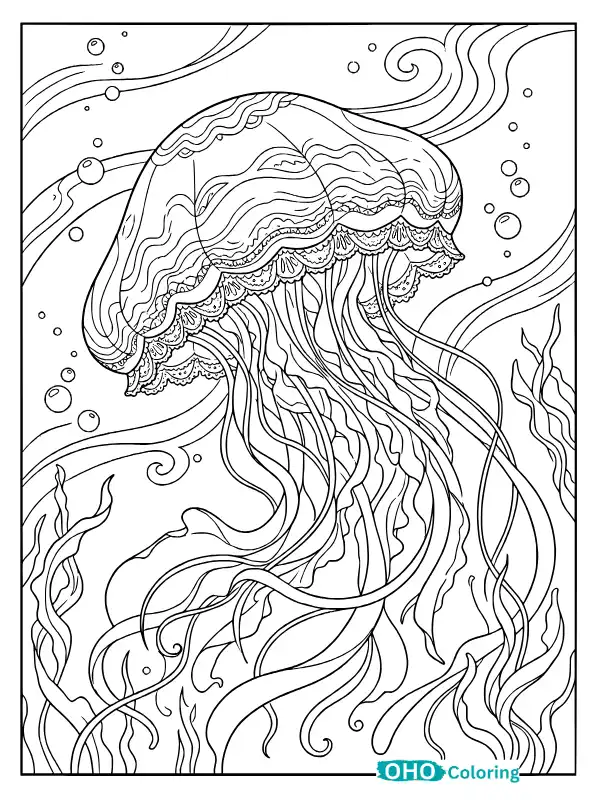
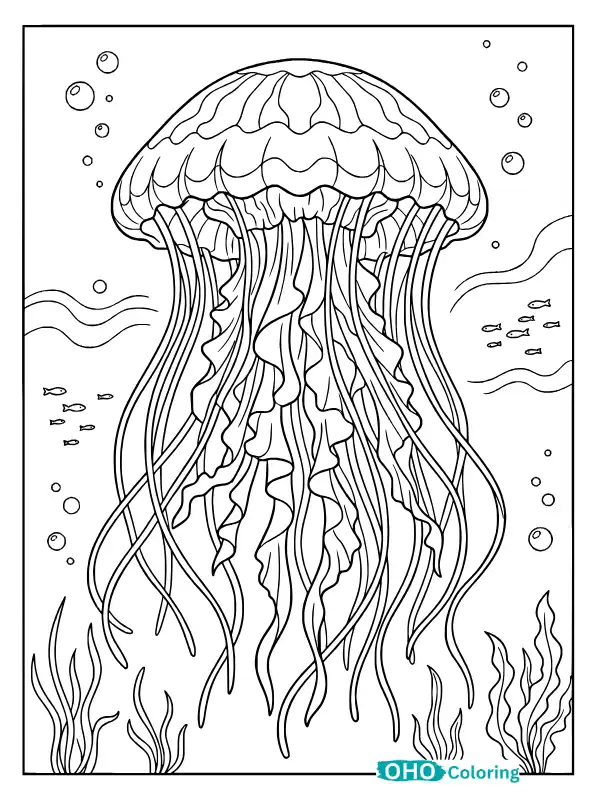
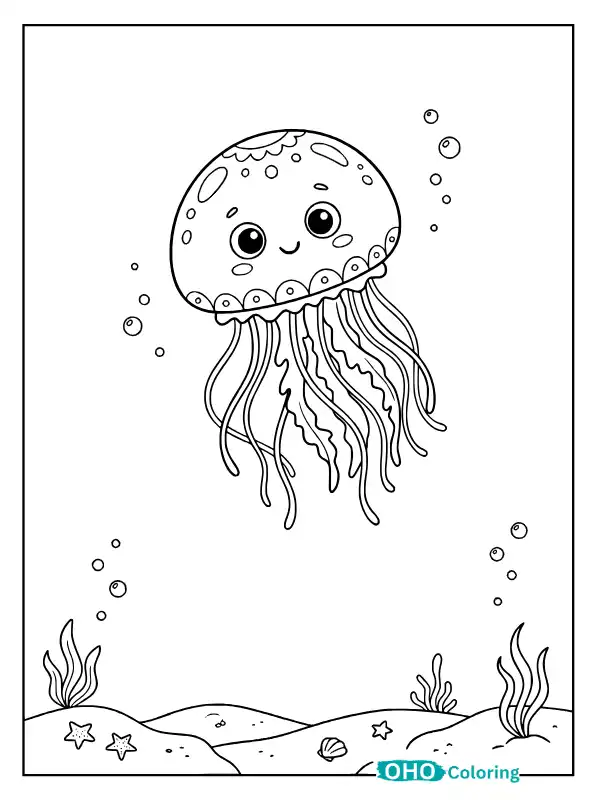
Emma named the calm jellyfish on the first page “Bello,” because the dome-shaped bell is the first thing you notice. Scientists call it the bell too. About 95 percent of a jellyfish’s body is water, which is why it looks see-through like glass. Emma left the middle of the bell blank and colored the edge with a light sky blue. “Look,” she said, “now you can really see right through it!”
The Bell Umbrella and the Answer to Emma’s Question
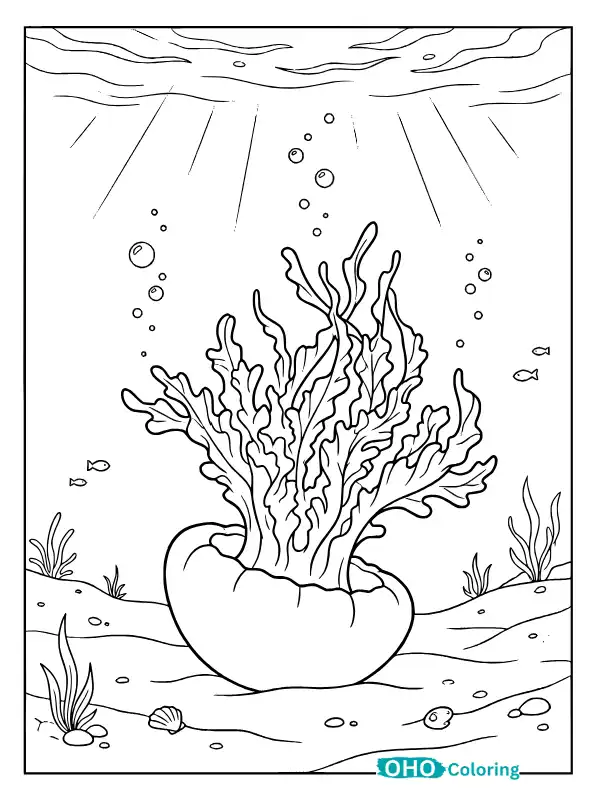
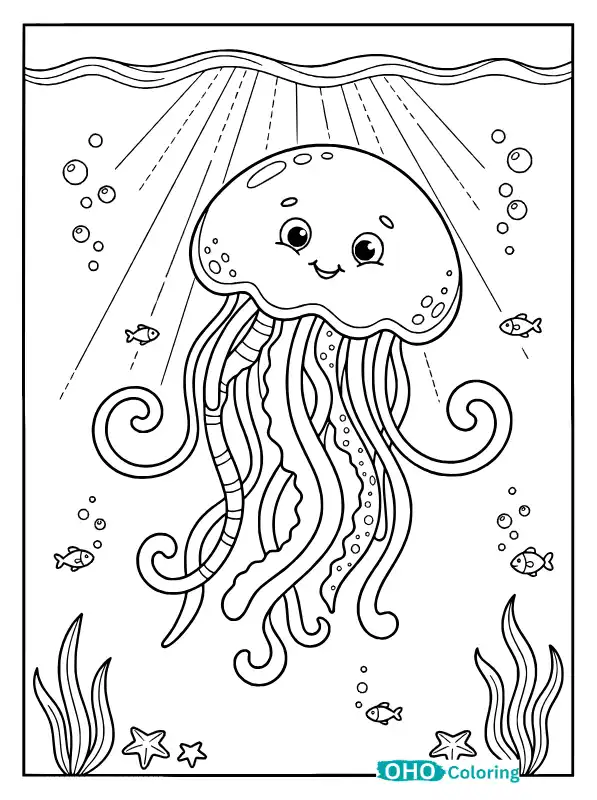
Then it was time to answer her big question. The little jellyfish on the next page is tilting sideways as it rides a stream of water. It squeezes its bell again and again to push water backward, like someone opening and closing an umbrella. That’s called jet propulsion. Instead of a brain, a jellyfish has a fine web of nerves that keeps the pulsing going. Emma filled the wave with deep blue and said, “So it doesn’t have to think, it just has to pulse!”
When the Light Went Out, the Jellyfish Lit Up
Next we flipped to the deep-sea pages, where sunlight never reaches. Many jellyfish down there make their own light, which is called bioluminescence. The atolla jellyfish is the cleverest of the bunch. When it’s in danger, it flashes bright pulses of light, like a burglar alarm going off.
The glow attracts bigger predators, and the attacker has to flee. On these pages, color the whole background in dark blue and black first. Then add glowing spots in yellow or light green, and shout “Lights on!” like Emma did.
Stinging Stripes Near the Coral Reef
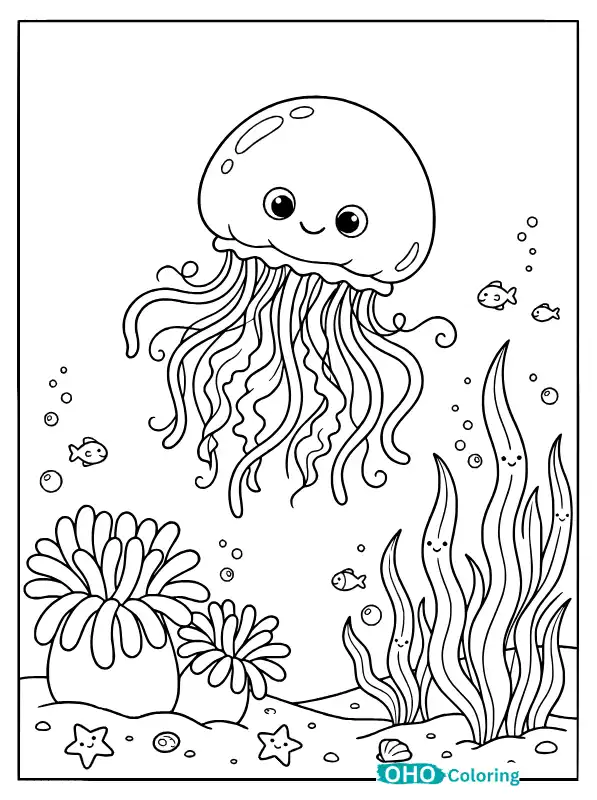
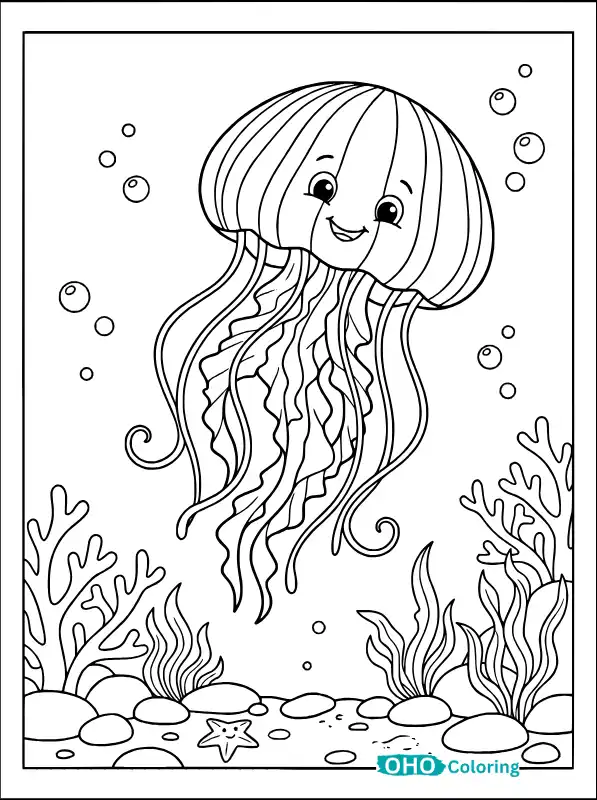
Leaving the dark behind, we swam into warm, shallow water, where a striped sea nettle jellyfish smiles near a coral reef. Don’t let the smile fool you, because its tentacles are lined with stinging cells called cnidocytes.
It uses them to catch plankton and small fish. That’s why, if you spot a jellyfish at the beach, it’s best to admire it from a distance and never touch it. On this page, color the stripes orange and brown, and the coral pink and purple.
How Did a Tiny Star Become a Big Jellyfish?
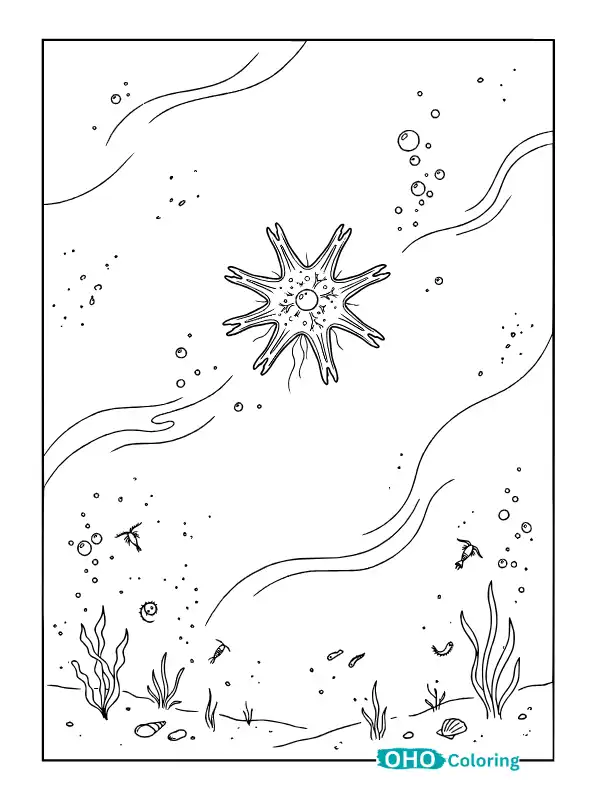
Where does such a big jellyfish even start? That was Emma’s next question, and the answer is hiding in three pages. On the first page, a trumpet-shaped polyp clings to a rock. Slowly it turns into a tower of tiny saucers, a stage called strobilation. Each saucer breaks away and swims off as an ephyra, a little star with eight pointed lobes. Emma colored all three pages in a row and said, “It’s a whole movie, just on paper!”
A Fish Hiding in the Tentacles and a Turtle Coming to Eat
Once a jellyfish grows up, it isn’t always alone. On one page, a tiny fish tucks itself among the long tentacles. It happens in the real ocean too, since many small fish hide in a jellyfish’s shadow to stay safe from predators. Still, not every story has a happy ending. On the next page in the same set, a sea turtle glides past a see-through moon jellyfish, and some sea turtles, especially leatherbacks, do eat jellyfish. Try two layers of green and brown on the turtle’s shell, and it will really pop.
The Jellyfish With a Mane as Long as a Blue Whale
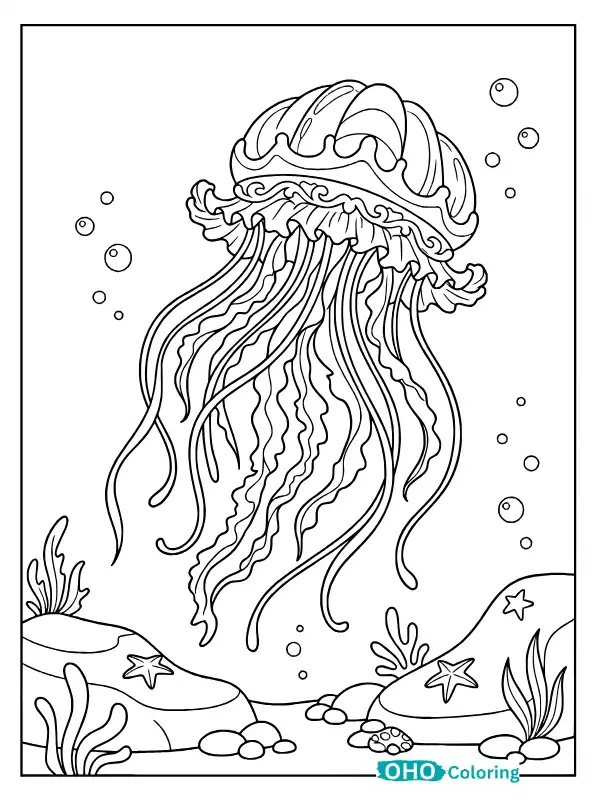
After the turtle, the biggest character in the set is the lion’s mane jellyfish. Thick, curtain-like arms flow beneath its wide bell, just like a lion’s mane, and that’s where it gets its name. It’s the largest known jellyfish species, and its tentacles can stretch over 100 feet, about the length of a blue whale. Emma blended the arms from red to orange to yellow, and the mane looked like it was blazing.
The Square-Bell Jellyfish and the One That Sunbathes
The last pages have the strangest characters. The box jellyfish has a square bell with thin tentacles hanging from all four corners. It has 24 eyes, and Emma cracked up when she heard that it still has no brain. The upside-down jellyfish is totally different. It lies on its back on the shallow sandy bottom and holds its arms up toward the sun. Tiny algae live inside its body and use sunlight to make food for it. That’s why it would rather sunbathe than swim.
Coloring Tips
Light colors work best for all these characters, so try sky blue, pink, lavender, and mint green. Use a slightly darker shade along the edge of the bell and a lighter one in the middle, and the rounded shape will stand out. Draw long wavy lines along the tentacles, and switch colors every few inches. On the deep-sea pages, add shiny dots with a white gel pen so the jellyfish really glows in the dark.
If you brush light blue watercolor over crayon, you’ll get bubble-like spots. Emma even made one jellyfish green and purple, and honestly, it turned out to be the cutest of all. Give each page 15 to 20 minutes, and ask a fun fact question now and then. When there’s talking along the way, the page doesn’t get rushed, and kids remember everything better.